Day 39: 9 maart 2006
Elmina - Gold Coast

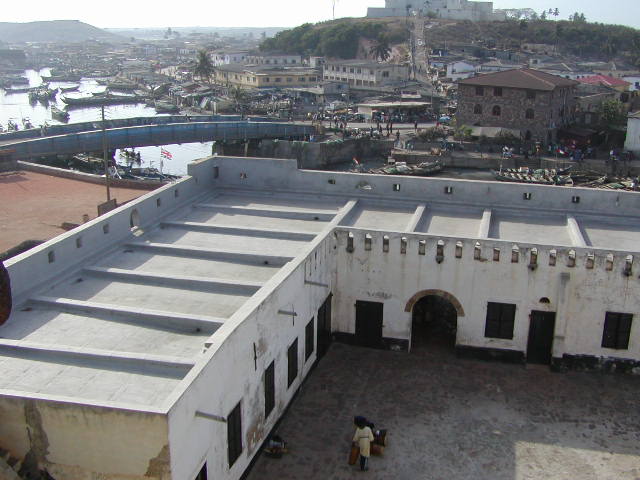
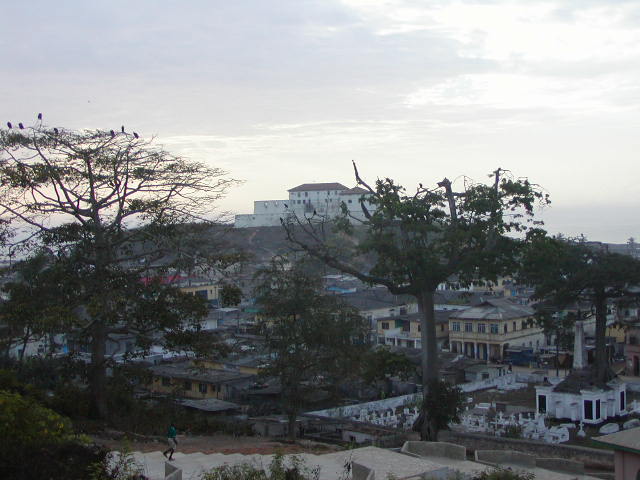
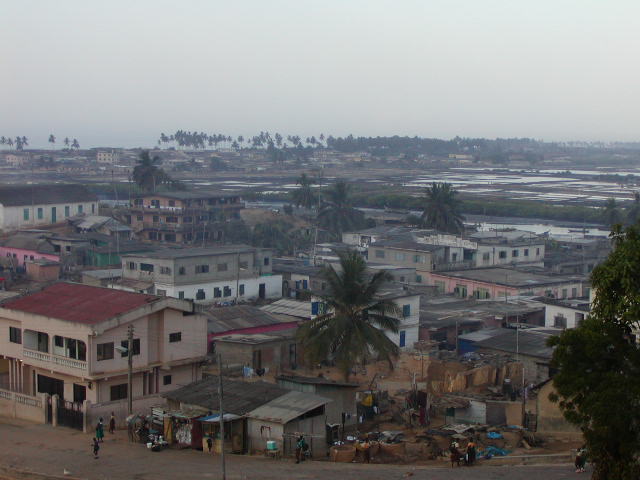
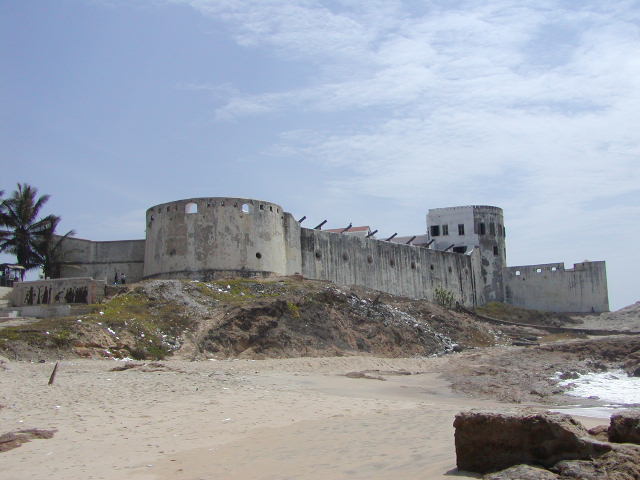
I got out of my bed even before sunrise and around 6 am I left for a walk to the village of Elmina. Along the road a lot of poor people tried to sell food. At the harbour the fishermen had arrived to sell their fresh fish. You only can enter the marketplace after you pay 500 cedis. It was already very crowded at this fish market. I walked on and passed the only bridge in this village. Nearby this bridge is also a hotel. On the other side of the bridge the old town starts, mainly build by the Dutch. Recent research revealed that about 40 % of the buildings are in a bad condition. To keep this history, an extensive restoration program started, which should be completed in 2015. I walked through the streets and indeed most buildings looked like they could collapse anytime. I passed an old cemetery, where a lot of Dutch people were buried. On a hill I visited a church. Next to the church there is a school and some children were doing some cleaning work, others were just waiting. From the hill I had a great view at the village and its surrounding. I walked back along the beach (with a lot of pollution), with a good view at the castle and around 8 am I returned to the guesthouse, where Emmanuel already was waiting (he slept in the same guesthouse).
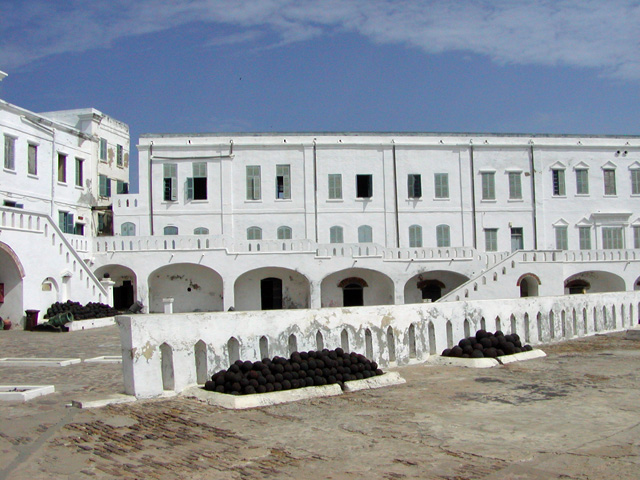
Around 8.15 am we left to Cape Coast to visit the Cape Coast castle, also known as Carolusburg. It was built by the Swedish in 1653. After paying the entry fee of 70.000 cedis (7 euro) I entered the castle. There was not a guide available so I was led to a museum. I almost stayed here for an hour. The displays are of good quality and tell about the way the former inhabitants used to live, the slave trade and even about some black people who played an important role in the history of the United States. There is not much historical material on display. Historians think that even about 30.000 years ago people used to live here.
After this visit of the museum I got a private tour around the castle. First I was led to the three dungeons of the castle. Nowadays it's an open space, but they used to be separated. In each compartment about 250 male slaves had to stay, sometimes for months. The lower compartment used to be the entrance to a tunnel. The entrance was closed by the English when they abolished the slave trade in the 19th century. Now it's a shrine where clergymen sometimes come to pray. It's also the place where a piece of the holy stone can be found. The locals used to have a holy place at the forest. This place was a big stone. By the time they had to run for the Europeans, they took a part of the stone with them. That piece is now on display.
The next part of the tour was the inner court. In those days it was not common that people were buried inside the castle. Still there are four graves here. Amazingly enough one of the graves contained the remains of a black priest. The man was not a slave, but was educated in England. Two other graves contain the remains of a soldier and his wife. The way they died is surrounded with a kind of mystery. Some say the woman was poisoned and the soldier died of grief. The fourth grave belongs to an officer who served at the castle. Along the inner court you still can see the remains of the tunnel. At the other end of the castle are the rooms where the female slaves were kept. There were 2 rooms where about 150 women had to stay. A lot of times the female slaves were raped. If they were "lucky", they became pregnant. Those women were released to a nearby village and often married the soldier who was responsible for their pregnancy. This is the reason why in this region a lot people still have European family names.
If the ships arrived, the slaves were transported to the beach. They had to go through "The door of no return". A couple of years ago some bones of slaves, who departed from here, were returned by the descendant. On the outside of the door they placed a sign "Door of return". The remains are buried in the neighbourhood. I also visited a big hall were the slave trade used to take place. Later this hall was used by the government, Cape Coast used to be the capital of Ghana. On top of the male dungeons there is a church.
After the visit to the castle I had a drink in the neighbouring drinking spot. This place is brand new, they were even busy decorating the tables. After enjoying the view at the Gulf of Guinea I went to the bank to change some money. Inside the bank it was nice and cool due to an air conditioning. I had to wait about 45 minutes before I was served.
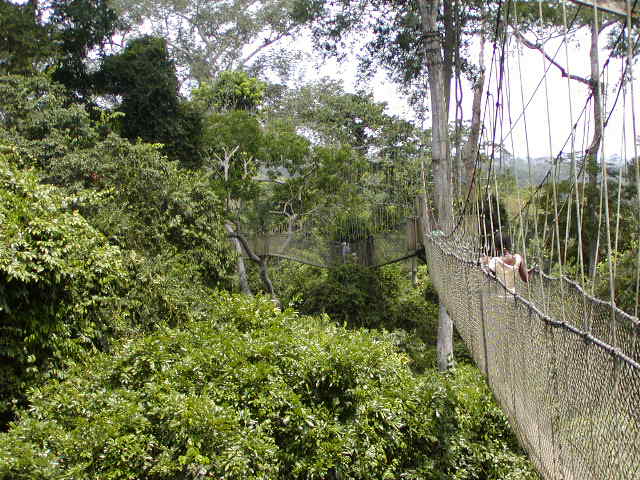
After I changed my money we drove on to Kakum National Park which is about 35 kilometers north from Cape Coast. After paying the 90.000 cedis (9 euro) I joined the group to go inside the park. First we had to climb up to a hill. On the way we saw a green Mamba (poisonous snake). After we reached the top we could enter one by one the 350 meter long canopy walkway, which is build in between the trees and separated in 6 parts. You really have the feeling you look down on the forest, the highest point is over 30 meters. Except for the many plants, there is not much to see.
After the walk I had a drink at the restaurant. Here I met 2 Dutch people who were cycling in Ghana for 3 weeks. After this I left with Emmanuel and I thought we would go to Cape Coast to stay there. But Emmanuel drove past the town and I was a little bit angry about that. It took more than an hour to find a guesthouse. Along the coast there are many hotels to stay, but they cost easily 40 up to 150 euro a night. After I settled down in my room, I had a shower and did some laundry. All with buckets, because the shower did not work.
When I was refreshed I went to the petrol station, because the people of the guesthouse told me I was able to eat there. When I arrived, the man behind the bar told me there was no more food left. I was not really happy with that, because I had not been eating all day. Luckily the man was so kind to offer me to fetch a meal in the nearby village. So I gave him some money and he went away by car. After half an hour I had rice and chicken in front of me, which I ate with pleasure. After smoking a cigarillo I walked back to the guesthouse. I went to my room to find out the electricity in this room was gone. They tried to fix it, but that did not work out. So they offered me another room. This room was more expensive and they wanted me to pay extra. I didn't, because I didn't want the extras. Around 10 pm I went to sleep.
Initial publication: 14 augustus 2008
Last update: 20 april 2010
© A. Heeroma
Click photo to enlarge