
This city in the southern part of Paraguay has about 70,000 inhabitants and has many old buildings. The city was founded in 1570 by Spanish captain Ruy Diaz de Melgarejo as Villa Rica del Espíritu Santo (holy spirit). They thought they could mine gold, but that turned out not to be. Also the earth was not really suitable for agriculture. Therefore the current city is not located at the place where she was once founded, that was more west to the Parana River. The move took place in 1682.
The city is now a trading center and the provincial capital. Religion also plays an important role. There is a lot of agriculture (cotton, sugar), cattle breeding and even wine production. It is also a university city. This city is also growing rapidly in size (population has doubled over the last 15 years). It also appears to be attracting more attention to tourists. In one way the city is quiet, with parks, shops, churches and likewise, but on also there is plenty of life. When I was there, there was just a car rally, but in February there is the annual carnival. Other Catholic celebrations are also held here.
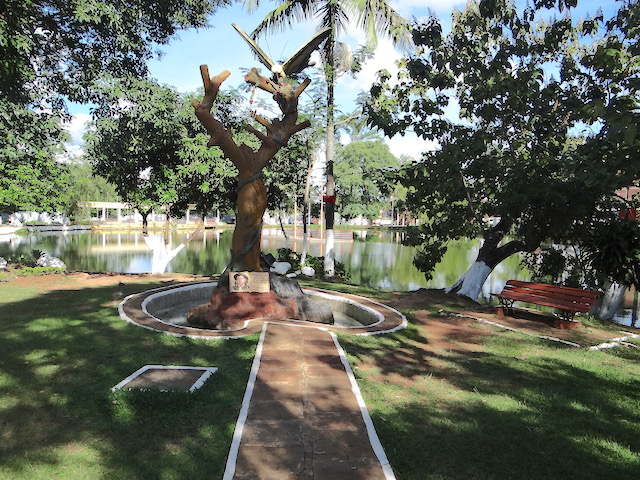
On the north side of the city is a park dedicated to the poet and musician Manuel Ortiz Guerrero. He was born in 1897 in this city. Although he was shy and even banned to Brazil, he is still honored here. The park was named after him in 1936, after his death (formerly it was called Ycua Pyta). The park is in a somewhat dilapidated state, but still worth the visit. Some poems of Guerrero can be found here. Near the park is also a vegetable and fruit market (stalls).
There are also some parks in the city center, such as Plaza de los Heroes and Plaza Libertad (at the Cathedral). Like other cities, the street structure here is block-shaped. A lot of houses are still in Spanish style.
First published: 29 October 2017
Last update: 29 October 2017
© A. Heeroma